
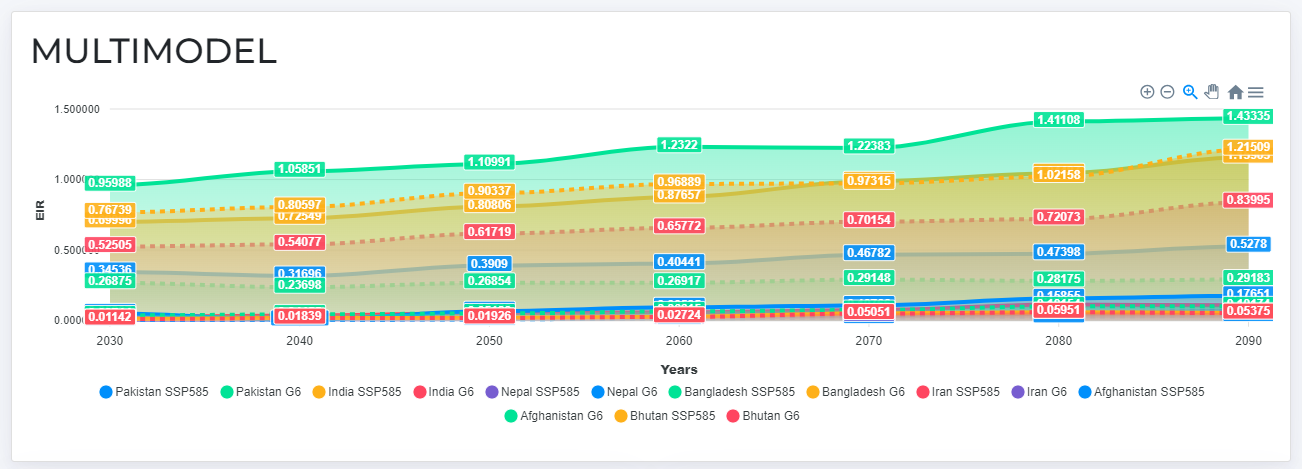
Under the GeoMIP project, several experiments projected future climate change, based on various greenhouse gas (GHG) emissions trajectories, and others projected solar radiation modification (SRM) techniques like stratospheric aerosol injection (SAI). Our efforts focus on two scenarios:
- One scenario focuses on climate change – SSP5-8.5, which is considered very high GHG emissions, seeing a tripling of GHG emissions by 2075; and
- One scenarios focuses on SAI – G6sulfur, which simulates injecting sulfur particles into the atmosphere from 2020 to 2100, and brings the level of warming down from SSP5-8.5 to SSP2-4.5 (intermediate GHG emissions, with emissions staying roughly the same till 2050, then falling, but not reaching net zero until 2100)
By comparing a world of high levels of GHG emissions (and higher climate impacts/risk) against a world of SRM, scientists, policy makers and civil society will be in a better position to judge the potential suitability of SRM technologies within the global climate response portfolio. This is referred to as risk-risk framing. Simply put, comparing the risks of worsening climate change against the risks of ill-understood SRM deployment when making decisions about resource allocation.
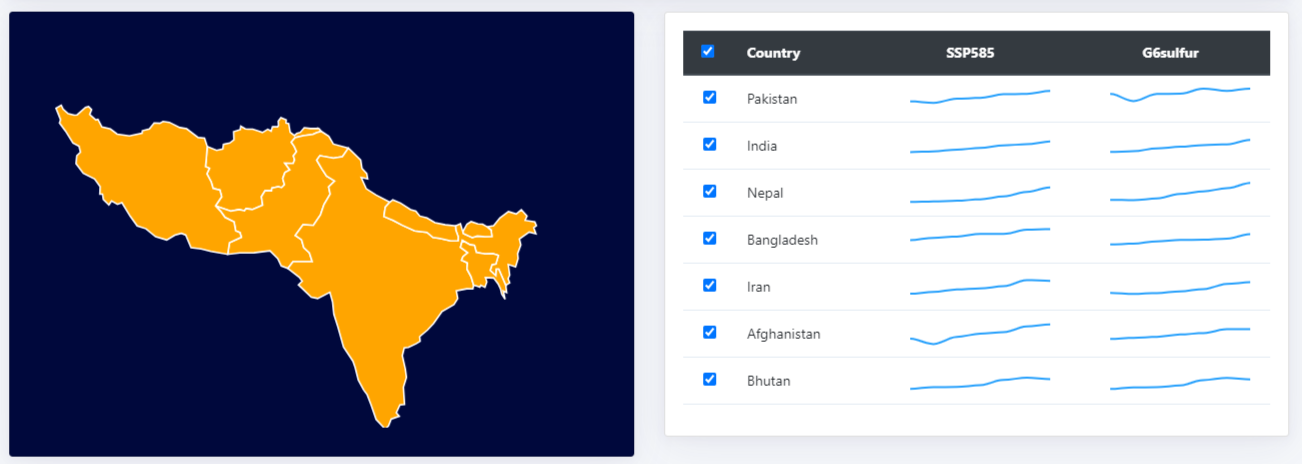
Although climate models have become more sophisticated and accurate as more investment in their development has occurred from various government and academic/research institutions, they still contain a degree of uncertainty when it comes to their simulations and projections. An MMEM in climate modeling is the average output generated from multiple climate models that simulate the same scenario. Instead of relying on a single model, multiple models are used to predict future climate conditions, and the results are averaged to produce a more robust and reliable forecast. Each model in the ensemble can have different strengths and weaknesses due to differences in how they represent climate processes, such as atmospheric dynamics, cloud formation, or ocean-atmosphere interactions.
Here we present an MMEM of malaria incidence rate for South Asian countries for both the climate change scenario (SSP5-8.5) and the SRM scenario (G6sulfur).